
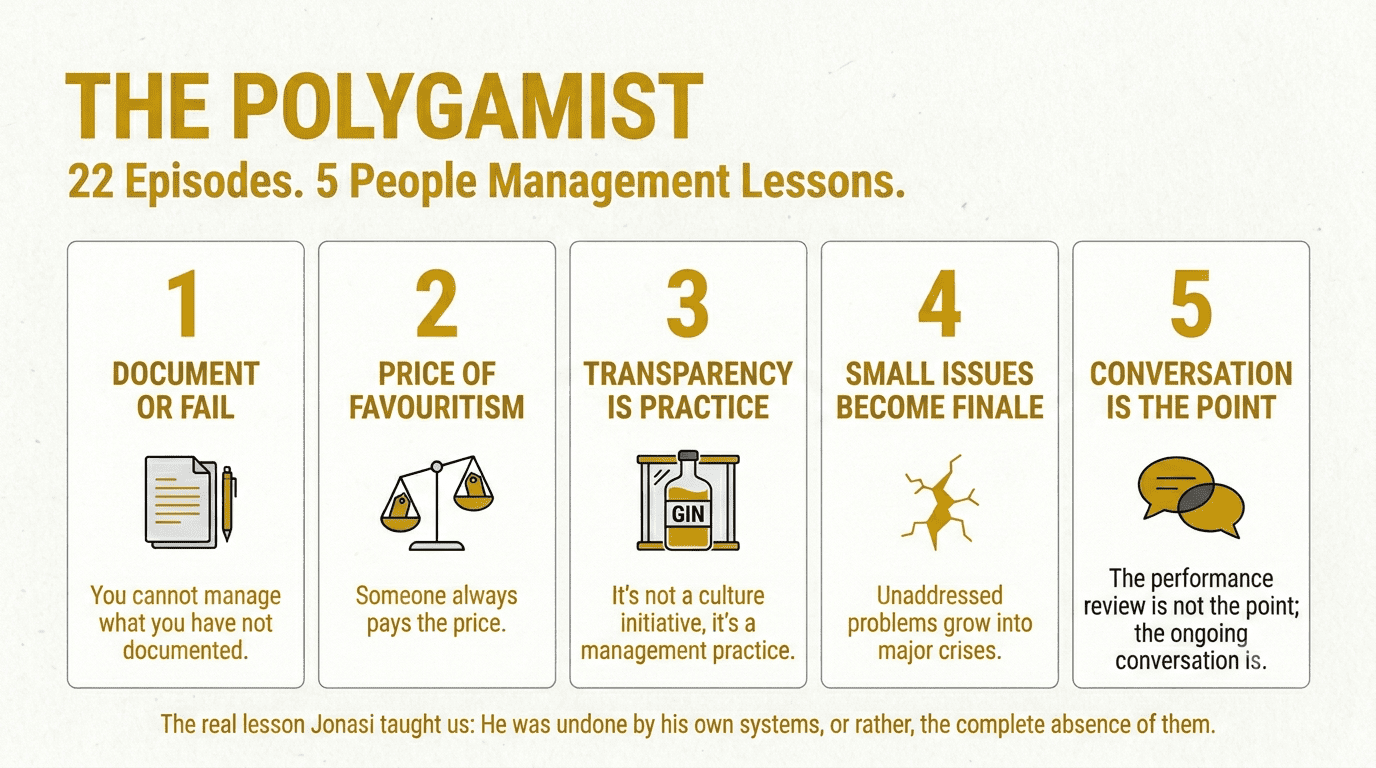
The Polygamist. 22 Episodes. 5 People Management Lessons.
Let's be honest. You stayed up until 2am watching it. You told yourself "just one more episode" somewhere around Episode 14, and then you blinked and it was Thursday. You arrived at work looking like you'd been through exactly the kind of emotional violence Joyce Gomora unleashed in Episode 22. You are not alone. The Polygamist dropped on Netflix on June 12 and within a week had clocked 19.1 million hours viewed globally, trended across every platform in Kenya, triggered a Kenyan preacher to warn his congregation, caused Milly wa Jesus to wonder aloud what exactly grown adults were doing with their evenings, and prompted Samidoh…Samidoh, to feel personally called out. The conversations haven't stopped. Which makes sense, because the show isn't really about polygamy. It's about what happens when someone builds an empire on secrets, treats different people by different rules, never documents anything, and assumes the whole thing will hold together because they're charming enough to keep all the plates spinning.
Sound familiar? Because watching Jonasi Gomora run his life looked uncomfortably like watching a company run its HR on WhatsApp and a shared Google Sheet.
1. You cannot manage what you have not documented — and neither could Jonasi
Jonasi Gomora was a self-made CEO. Successful by every visible measure. But the moment he died, everything collapsed…not because the business was bad, but because nothing was written down. No one had the full picture. Every relationship he had was built on a separate version of the truth, maintained in his head, surviving only as long as he was alive to manage it. Here is a question Kenyan HR managers are asked constantly: "How many days of leave does so-and-so have left?" In most offices, the honest answer is: "Let me check the spreadsheet. Actually, let me check with Grace. Actually, I think she tracks it in a notebook." When the person who holds that information in their head is gone, on leave, sick, or simply overwhelmed…the whole thing falls apart. Jonasi's household and many Kenyan offices have this in common: the records exist, but only in one person's memory.
If leave balances, attendance, contracts, and performance history are not recorded somewhere that survives a single person's absence, you do not have records. You have a time bomb
2. Favouritism has a price tag, and someone always pays it
Jonasi had a first wife, a second wife, and more arrangements besides. Each one operated under different rules. Joyce got the title and the public respectability. Matipa got the resources and the access. Others got less of everything and still stayed, because they had no visibility into what the others were getting. In an office, this plays out quietly. The employee who shares the boss's politics gets the stretch assignment. The one who laughs at the right jokes gets approved for training. The rules about remote work, overtime approval, or leave notice periods somehow apply differently depending on who is asking. The problem is not that managers have preferences, humans always will. The problem is when those preferences are never written down, so there is no policy to hold anyone to. When everything is discretionary, discretion always favours someone, and it is rarely the person who most needs it.
A leave policy is not bureaucracy. It is the guarantee that Wanjiku and Njoroge are measured by the same ruler. Jonasi never had a consistent ruler. His household noticed. Your team notices too.
3. Transparency is not a culture initiative — it's a management practice
One of the most devastating moments in The Polygamist is watching Joyce piece things together, not because she was told, but because she went looking. Bank statements. Receipts. Conversations that didn't quite add up. The information was always there. It was just never shared with the people who needed it. Kenyan workplaces have a version of this. The company restructure that employees find out about through a rumour in the lift. The poor performance feedback that exists in a manager's head but was never communicated clearly, and only surfaces on the day someone is being let go. The contract renewal, or non-renewal, that catches an employee by surprise because no one thought to tell them. When people operate without information, they fill the gap with speculation. Jonasi's household ran on speculation, and look how that turned out. Teams do the same: quiet resentment, quiet exits, quiet disengagement, all of it is the organisational equivalent of Joyce finding those bank statements and saying nothing while she plans her next move.
Transparency is not a values statement on the wall. It is telling your team what they need to know, in time for it to matter.
4. Small issues unaddressed become the season finale
The Polygamist opens with Jonasi's death. Then the show goes back to show you, episode by episode, every warning sign that was missed, every conversation that was avoided, every moment where someone could have addressed something and chose not to. By the time the crisis arrives, it is not a surprise. It was always coming. Everyone just looked away. This is precisely how performance issues work in most Kenyan companies. A manager notices that someone is consistently late. They say nothing because it feels awkward. The person is late for three more months. Now the pattern is established, the team has noticed, and a conversation that could have been a two-minute chat in week one is now a formal process with documentation nobody kept, about a problem that went unaddressed for a year. The Employment Act 2007 is actually quite clear about fair process: notice, hearing, outcome. Not because the law is trying to make your life difficult, but because when things go wrong, and they sometimes will, the record of how you handled it matters enormously. The companies that find themselves in a labour dispute they cannot win are almost always the ones that never wrote anything down while the situation was still manageable.
The check-in you delay is the season finale you are writing.
5. The performance review is not the point — the ongoing conversation is
Here is what nobody online is saying about The Polygamist, but should be: Joyce Gomora is a masterclass in sustained, unacknowledged performance. She built the brand. She maintained the home. She managed the public image. She did 20 years of exceptional work with zero genuine feedback, zero acknowledgement of what it was costing her, and zero honest conversation about whether any of it was sustainable. When the review finally came, in the form of a funeral and an inheritance dispute, it was too late for any of it to count. High performers leave quietly in Kenyan companies for the same reason. Not because they were not working hard. Because nobody noticed. Because the only time the conversation about performance happened was when something went wrong, never when things were going right. Recognition is not a soft skill. It is what makes people stay. And regular, honest check-ins, not the annual review that everyone dreads, are what surface issues before they become irreversible.
Joyce deserved better. So does your best employee.
The real lesson Jonasi taught us
Jonasi Gomora was not undone by his enemies. He was undone by his own systems, or rather, the complete absence of them. No transparency, no documentation, no consistent standards, no ongoing honest conversations. He relied entirely on his personal ability to manage every relationship individually, by feel, in his head. That works brilliantly right up to the moment it doesn't. Every small business in Kenya that is growing past the point where one person can hold everything in their head is at exactly this inflection point. The moment your team is more than ten people, the founder's memory is no longer a reliable HR system. The moment you have more than one manager, the rules need to be written down somewhere both of them can read. The good news, which Jonasi never got, is that this part is solvable.
alantaHR is HR software built for Kenyan businesses. Leave balances, attendance records, performance reviews, employee documents, and policies — in one place that anyone with the right access can find, and nobody can accidentally lose. If your HR currently lives in someone's memory, a shared spreadsheet, or a group chat, we built this for you.