Salaries, ID numbers, medical notes, disciplinary records — HR holds the most personal data in any business. TalantaHR is built so the right people can do their jobs, the wrong people can’t see what they shouldn’t, and you can prove both to a regulator.
Data Protection Act 2019Employment Act 2007OSHA 2007
How we protect data
Four habits, built into every screen.
Role-based access, least privilege
Everyone gets exactly the access their job needs — no more. An employee can’t open a colleague’s file; a manager sees only their team; HR configures policy. Permissions are granular per module and scoped to self, team or organisation.
Every sensitive action, logged
Who viewed a record, who changed it, when, and from where — captured automatically. When a Data Protection Act request or an internal investigation lands, the audit trail is already there and can’t be quietly edited.
Protected document viewer
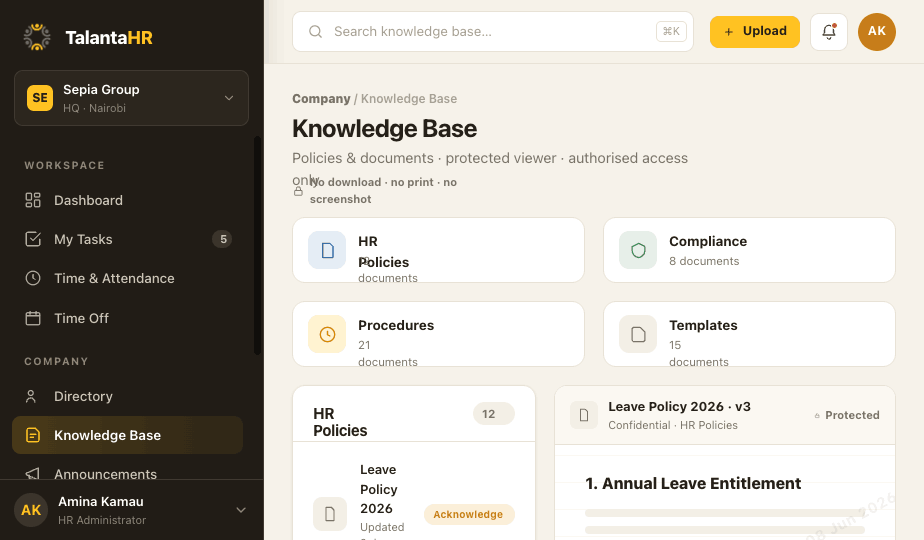
Policies, contracts and handbooks open in a viewer with no download, no print and no delete. A watermark with the reader’s identity follows the page, every open is logged, and a read-acknowledgement is recorded.
Consent & data minimisation
Collect what you need and record the basis for holding it. Data subjects can be given access to their own records, and retention rules keep you from holding personal data longer than you should.
Role-based access in practice
The same system. Three very different views.
Access isn’t an afterthought you configure later — it’s the first thing the system checks on every screen. If a role doesn’t have permission, the data simply isn’t there to see.
JM
Employee
Sees only their own records and self-service actions
DO
Manager
Sees the team that reports to them — approvals, attendance, reviews
AK
HR & owner
Configures policy and sees the whole organisation
Knowledge base · protected viewer
Kenyan statutory compliance
The law isn’t a checkbox. It’s the floor we build on.
TalantaHR encodes the Kenyan rules that matter most to HR, so compliance is the default behaviour of the system — not a policy you hope everyone remembers.
Employment Act 2007
Leave, contracts & fair process
Annual, sick, maternity and paternity leave are configured as statutory floor-locks — your policy can be more generous, never less. Contracts, notice periods and a fair disciplinary and separation process are built into the workflow.
Data Protection Act 2019
Privacy & accountability
Personal data is access-controlled and logged, documents are viewed under watermark, and you can show exactly who touched what. Retention and consent are tracked so you can answer a data subject request with confidence.
OSHA 2007
Safety & welfare records
Keep occupational safety and health records — incidents, training and acknowledgements — organised and retrievable, so a safety audit is a search, not a scramble through filing cabinets.
A note on scope. TalantaHR helps you meet your obligations under Kenyan law, but it doesn’t replace legal advice. Statutory floor-locks and templates reflect the Acts as configured for your organisation — your own counsel remains the authority on how the law applies to your business.
What you can prove
When someone asks, you have the answer.
The difference between a stressful audit and a calm one is whether the records exist and can be found. With TalantaHR, they do — and they can.
Who accessed an employee's data, and when.
That every employee acknowledged the current policy.
That leave never dropped below the statutory minimum.
A complete, timestamped history for any record.
Security questions
What teams ask their IT and legal people.
Is TalantaHR compliant with the Data Protection Act 2019?
TalantaHR is built around the Data Protection Act 2019. Access to personal data is role-based and least-privilege, every view and edit of a sensitive record is logged, and policy documents are shown in a protected viewer with a read-acknowledgement trail.
What exactly is role-based access control?
It means each person only sees and does what their role allows. An employee sees their own records, a manager sees their team, HR sees the organisation. Permissions are granular per module — view, create, edit, delete and approve — and scoped to self, team or all.
How does TalantaHR enforce the Employment Act 2007?
Statutory minimums — annual, sick, maternity and paternity leave — are configured as floor-locks in Set-ups. Your own policy can be more generous, but the system won't let a configuration or an approval fall below the legal minimum.
Where is our data stored?
Your data is yours. We'll walk your IT and legal teams through hosting, encryption, backups and data residency during the demo, and provide our data processing terms so everyone is comfortable before you commit.
Bring your toughest compliance question.
Book a demo and put your IT and legal people in the room. We’ll show you exactly how access, logging and statutory rules work.